How much is an acre of land worth?
The short answer: US farmland averaged $4,500 an acre in 2026. The useful answer is that it depends almost entirely on what the land can be used for and where it sits. An acre of pasture in New Mexico and an acre in Rhode Island are worth thirty times apart, and a building lot at the edge of a growing town can beat both.
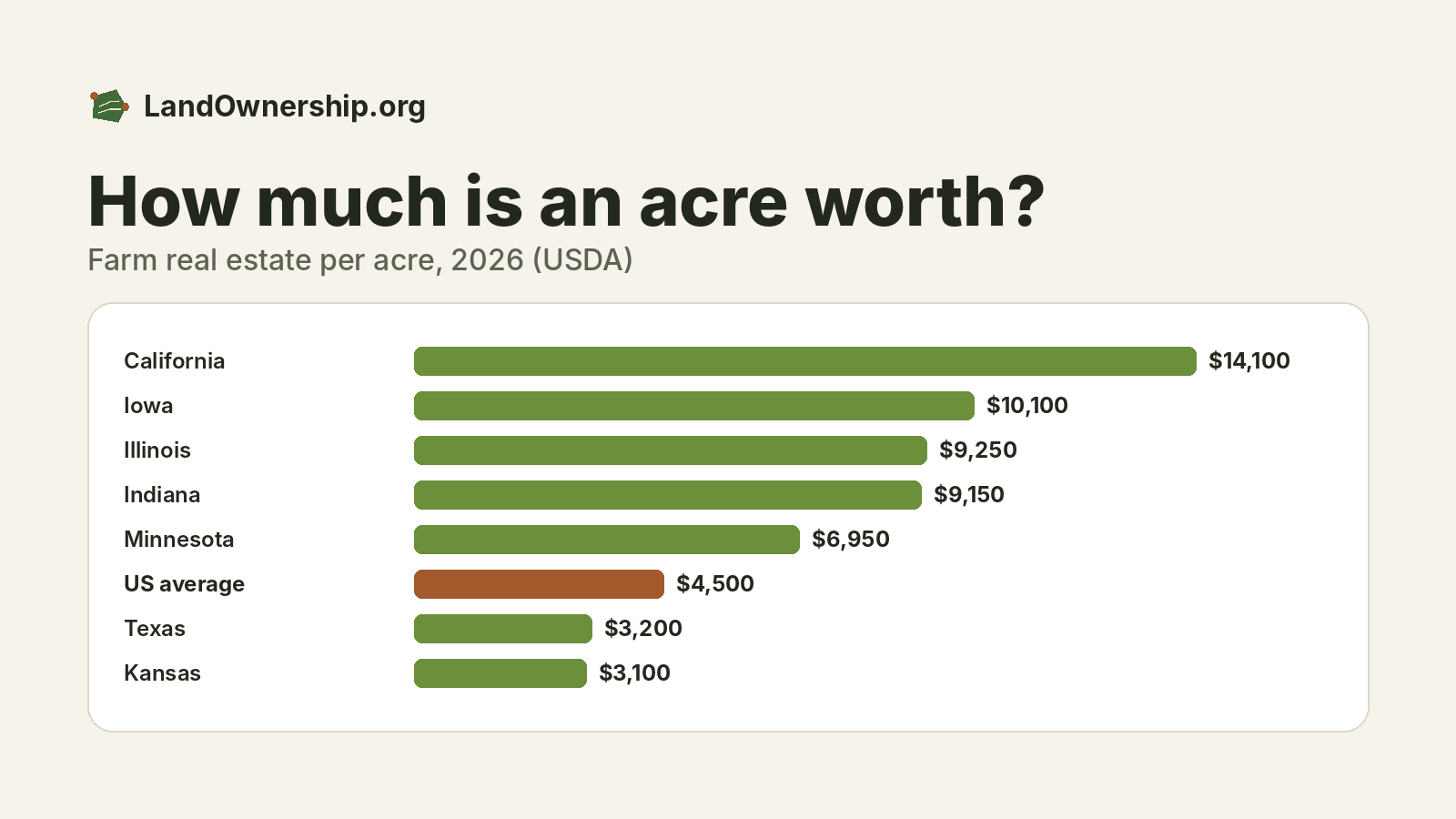
The national average price per acre
The best single benchmark is USDA's annual Land Values Summary, built from a survey of about 30,000 farm operations. For 2026 it put average US farm real estate (land plus farm buildings) at $4,500 an acre, up about 3.4% from 2025. Cropland averaged $6,020 and pasture $2,000 an acre.
Those are farm figures. They don't describe house lots, lakefront parcels or land zoned for development, which usually sell for far more per acre.
Average land value by state
State averages vary enormously. Rhode Island had the highest farm real estate value in 2026 at $23,600 an acre, and New Mexico the lowest at $735. Here are the ten biggest farm states by agricultural sales, as reported by DTN from the USDA figures:
| State | Farm real estate, 2026 | Change from 2025 |
|---|---|---|
| California | $14,100 | +2.9% |
| Iowa | $10,100 | +3.2% |
| Illinois | $9,250 | +3.6% |
| Indiana | $9,150 | +3.4% |
| Minnesota | $6,950 | +2.4% |
| Wisconsin | $6,700 | +4.4% |
| North Carolina | $5,750 | +5.1% |
| Nebraska | $4,400 | +3.5% |
| Texas | $3,200 | +3.2% |
| Kansas | $3,100 | +4.2% |
What makes one acre worth more than another
- What it can be used for. Zoning and soil decide whether land can carry a house, a subdivision, row crops or only cattle. Development potential outweighs almost everything else.
- Location. Land within commuting distance of a growing town is priced for future homes, not crops.
- Access and utilities. Legal road access and power at the boundary add real value. Landlocked land sells at a steep discount.
- Water. Wells, irrigation rights, creeks and lake frontage all raise prices, and in dry states water rights can be worth more than the land.
- Size. Small parcels nearly always cost more per acre than large ones.
- Buildable area. Slopes, wetlands and flood zones shrink the part of a parcel you can use.
How to find out what land near you is worth
- Look up recent sales, not asking prices. County recorder and assessor records list sale prices. Listings can sit unsold for years at prices nobody pays.
- Compare like with like. Match size, use, access and utilities as closely as you can, and work out each sale's price per acre. The price per acre calculator does this even when sales are listed in different units.
- Ask people who sell land. A local agent who specializes in land can pull comparable sales. For a loan, estate or dispute, hire a licensed appraiser.
- Multiply out. Value of a parcel = price per acre × acres. Check the acreage too: the land area calculator works it out from the side lengths.
What land earns while you hold it
Vacant land doesn't pay you unless it's farmed, leased or developed, and it costs property tax every year. Farmland can be rented out: USDA's survey put average US cropland cash rent at $160 an acre in 2026. Timber, hunting leases and grazing are other ways land earns its keep. Weigh that against the yearly tax bill, which the property tax calculator can estimate.
Figures are USDA averages for farm real estate and are not an appraisal of any parcel.
Frequently asked questions
How much is an acre of land worth in the US?
USDA put average US farm real estate (land and farm buildings) at $4,500 an acre in 2026. Cropland averaged $6,020 and pasture $2,000. Building lots and land near growing towns usually sell for much more.
Which state has the most expensive farmland?
Rhode Island had the highest average farm real estate value in 2026 at $23,600 an acre, and New Mexico the lowest at $735, according to USDA.
How do I find out what my land is worth?
Look up recent sales of similar parcels nearby in county records, compare their price per acre, and ask a local land agent or a licensed appraiser for a formal value.