What is raw land?
Raw land is land in its natural state: no road built to it, no power, no water or sewer, no structures. It's the cheapest land per acre you can buy and the most work to turn into anything. Whether that's a bargain or a money pit depends on what you plan to do with it and how much getting there costs.
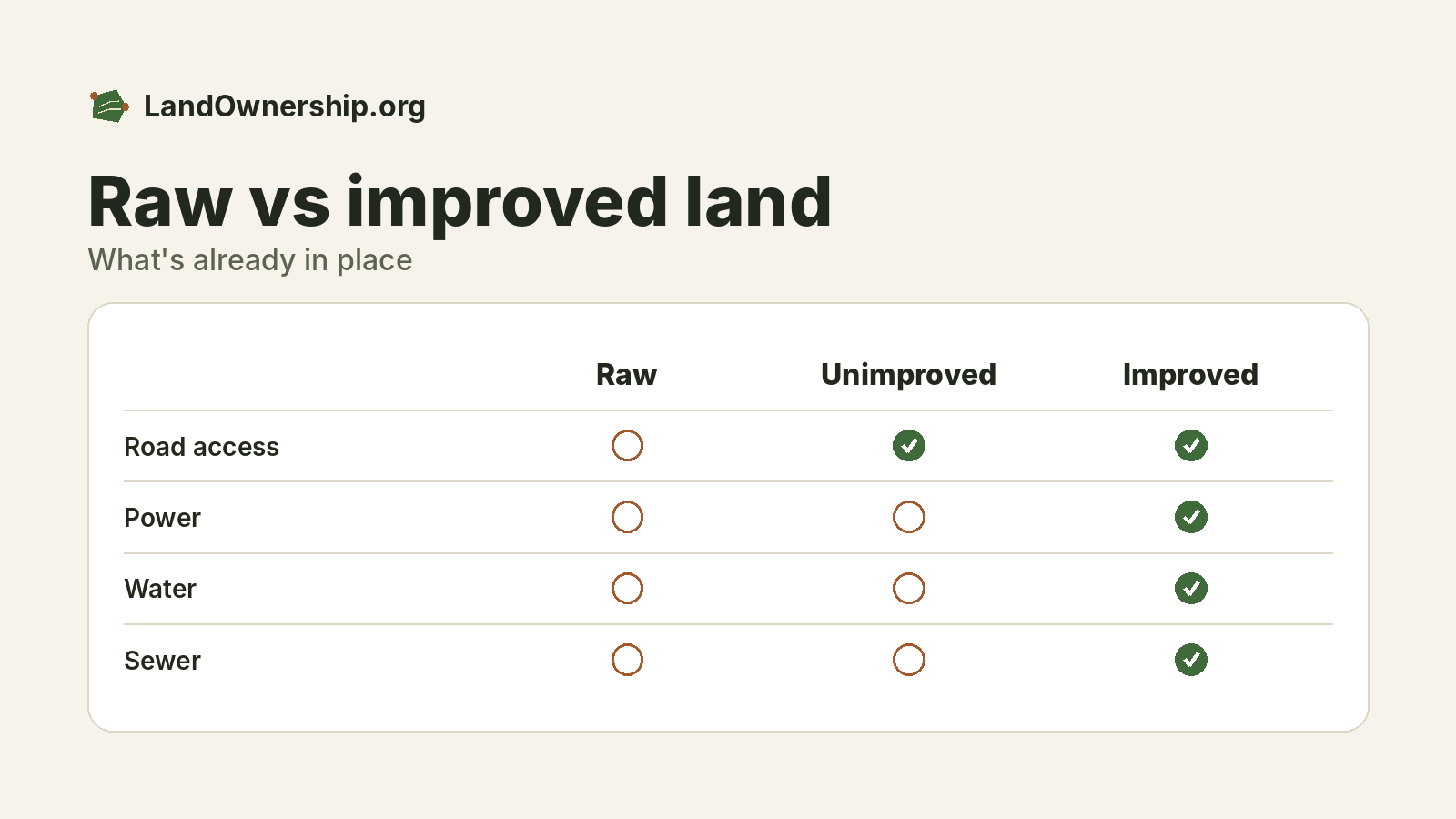
Raw, unimproved and improved land
Lenders and agents sort land into three rough groups. The labels overlap a bit, but the idea is how much has already been done:
| Type | What it has | Typical land loan down payment |
|---|---|---|
| Raw | Nothing: no road, utilities or structures | 30% to 50% |
| Unimproved | Some basics, often road access, but not all utilities | 20% to 30% |
| Improved | Road access, power, water and sewer in place | 15% to 20% |
Why buy raw land?
- Lower price per acre. You're not paying for work someone else did.
- Room and privacy. Raw land is often larger and farther out.
- Your own layout. You choose where the house, driveway, well and septic go.
- Recreation and timber. Hunting, camping and woodland don't need utilities at all.
The downsides
- Harder to finance. Bigger down payments, shorter terms and fewer lenders. See how land loans work.
- Expensive to make buildable. Roads, power, a well and septic can add up to more than the land cost.
- Unknowns. Soil, water, access and wetlands haven't been tested by a previous owner, so you have to check them.
- Slower to sell. Fewer buyers can pay cash or take on the work.
What it costs to make raw land buildable
Every parcel is different, but these are the usual jobs, with published US ranges where good data exists:
| Job | Typical cost |
|---|---|
| Boundary survey | $1,500 to $2,000 for 5 acres; more on larger or rough land (estimator) |
| Clearing a building site | $500 to $2,000 an acre if lightly wooded; $3,000 to $5,600 if heavily wooded (calculator) |
| Perc test for a septic system | About $1,300 on average (guide) |
| Driveway, power line, well, septic system | Highly local: get quotes from the power company and local contractors before you buy |
Ask the electric utility for a written estimate to run power to your building site. On remote parcels it can be one of the largest costs, and some buyers choose solar instead.
Due diligence before you buy raw land
- Confirm legal access from a public road or a recorded easement.
- Check zoning and any restrictions on homes, mobile homes, animals or minimum lot size.
- Get a perc test or soil evaluation if there's no sewer.
- Look the parcel up on FEMA flood maps and check for wetlands.
- Order a survey and title search, and ask whether mineral, timber and water rights come with the land.
- Get quotes for power, well and septic, and add them to the price before deciding.
Who should buy raw land?
Raw land suits buyers with time and cash: people who'll hold it for years, use it for recreation, or are ready to manage a build from the ground up. If you need to move in soon or borrow most of the price, improved land or an existing home is usually the easier path. Either way, compare parcels by total cost, not sticker price. The price per acre calculator helps line them up.
Frequently asked questions
What is raw land?
Land in its natural state with no road access, utilities or structures. It's the cheapest land per acre but needs the most work and money to become buildable.
What is the difference between raw and improved land?
Improved land already has road access, power, water and sewer. Unimproved land has some of these, often a road. Raw land has none.
Is raw land harder to finance?
Yes. Lenders typically want 30% to 50% down for raw land, compared with 15% to 20% for improved land.