Landlocked property and easements
Landlocked property has no legal way to reach it from a public road. You might be able to see the road, even drive to the land today on a neighbor's track, but without a recorded right to cross, that access can disappear. Lack of access is one of the most expensive mistakes in buying land, and one of the easiest to check.
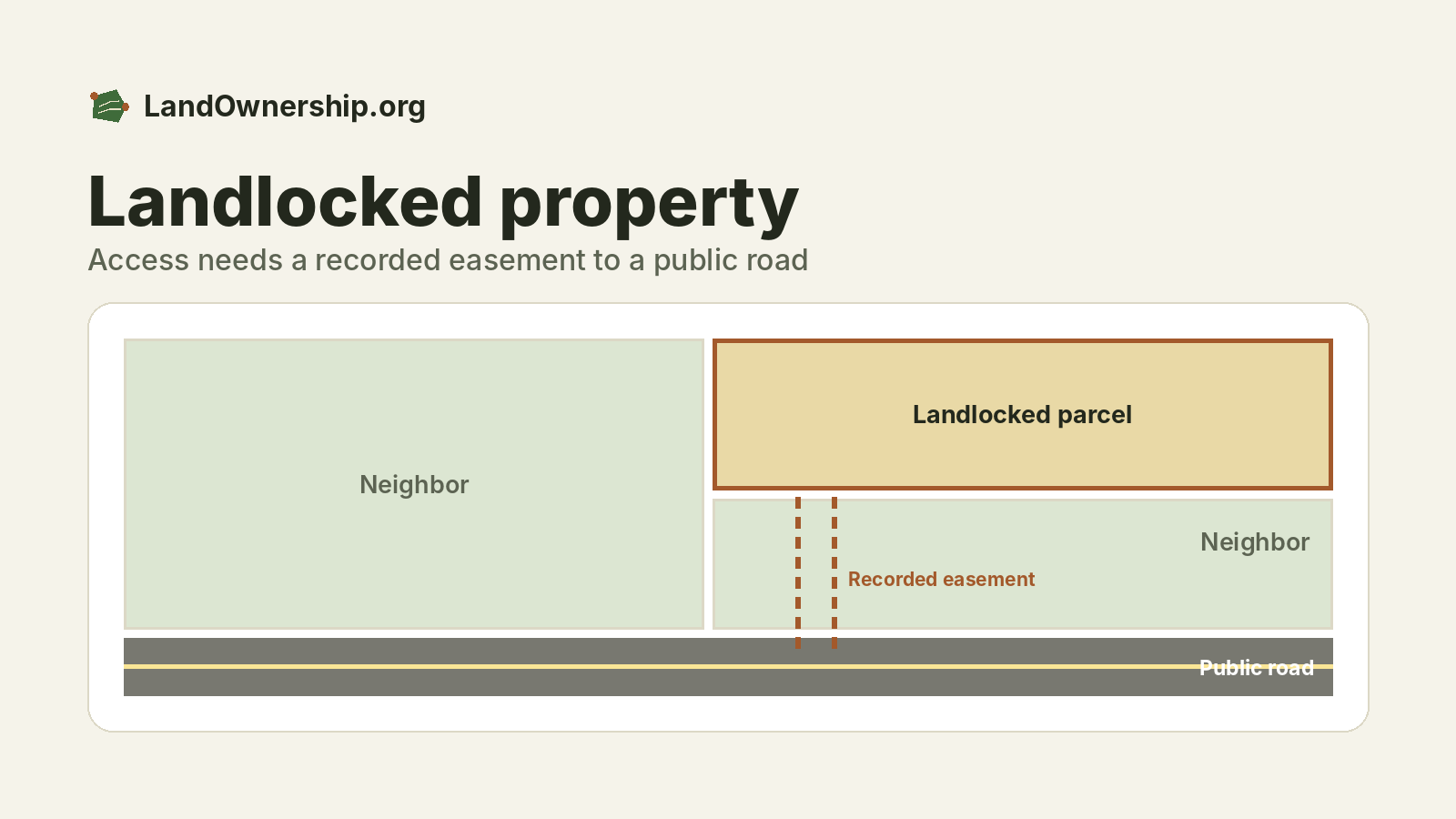
What "landlocked" means
As Cornell's Legal Information Institute explains, landlocked property is surrounded by other land with no access to a public road. The fix is almost always an easement: a legal right to cross someone else's land for a set purpose, such as a driveway. An easement that comes with a parcel usually stays with it when the land is sold.
Why access matters so much
- Building: counties can refuse a building permit for land without legal access.
- Financing: lenders are wary of land without recorded access, and title companies may not insure it.
- Resale: buyers and their lenders will ask the same questions you should be asking now.
- Utilities: power and phone lines also need a right to cross neighboring land.
Types of easements
| Easement | How it's created | How secure it is |
|---|---|---|
| Express (by grant) | A written agreement, recorded in the county land records | The strongest. What you want to see. |
| By necessity | A court finds one when land was split and one part was left with no access | Needs a legal case; the rules are strict |
| Implied by prior use | A court finds one from a long, obvious use that existed when the land was divided | Needs evidence and often a court |
| By prescription | Open, continuous use without permission for a period set by state law | Needs a court; permission defeats it |
Easement by necessity
Courts can create a right of way to landlocked land, but only in narrow cases. A Texas A&M AgriLife guide lists the usual three requirements: the landlocked parcel and the land to be crossed were once owned by the same person; the access is a true necessity, not just a convenience; and that necessity existed when the land was divided. Miss any one and the claim fails. Rules differ by state, and some states have separate procedures for landlocked owners.
Easement by prescription
This works a bit like adverse possession: someone uses a route openly, continuously and without the owner's permission for the period state law sets (for example, 15 years in Vermont). If the owner gave permission, there's no prescriptive easement. Claims usually end up in court and aren't something to rely on when you buy.
How to check access before you buy
- Ask for the recorded easement. If access crosses another parcel, there should be a written easement in the county records. A handshake deal with the current neighbor isn't enough.
- Read the title commitment. It lists recorded easements. Ask the title company whether the policy will insure legal access.
- Get a survey. A boundary survey shows where the road and any easement actually run, and whether the driveway stays inside it. See the land survey cost estimator.
- Check the easement's wording. Width, permitted uses (driveway, utilities, both), who maintains it, and whether it covers a future house or more than one home.
- Make access a contract condition. If it isn't confirmed, you should be able to walk away.
If you own landlocked land
- Negotiate. The usual route is to buy an easement, or a strip of land, from a neighbor and record it.
- Look at the history. If your parcel was split from a neighbor's, you may have a claim to an easement by necessity or prior use.
- Talk to a real estate attorney before using a route or going to court, since the rules vary by state.
Access is check number four in how to buy land. It also shapes value: landlocked parcels sell for much less, so factor it into the price per acre.
General information, not legal advice. Easement law differs by state.
Frequently asked questions
What is landlocked property?
Land with no legal access to a public road. Access usually depends on an easement, a legal right to cross a neighbor's land.
Can you build on landlocked land?
Often not until you have legal access. Counties can refuse building permits, and lenders and title insurers may not support a purchase without recorded access.
What is an easement by necessity?
A right of way a court can create when land was split and one part was left with no access. It usually requires common past ownership, true necessity and that the necessity existed when the land was divided.